
DIGITAL DABUR
Embedding Digital Across The Enterprise
During 2025–26, Dabur continued to strengthen its digital and information technology capabilities with a clear focus on improving operational efficiency, enabling data-driven decision-making, and supporting business teams through scalable technology solutions.
A key theme during the year was the accelerated adoption of artificial intelligence (AI), alongside sustained investments in enterprise platforms, data governance, and secure digital infrastructure. The overall approach remained pragmatic - prioritizing initiatives that deliver measurable business value, are scalable across functions, and align with evolving operational requirements.
These digital and IT initiatives contributed to improved business performance, enhanced operational efficiency, and stronger engagement with consumers and trade partners, positioning the organisation for sustained growth in an increasingly digital-first environment.

DRIVING DIGITAL EXCELLENCE & AI TRANSFORMATION
Strategic AI Framework
A major focus during the year was the structured and responsible adoption of artificial intelligence across key business functions. A centralized AI framework was established to identify, prioritize, and scale AI-led use cases across Sales, Marketing, Commercial, and Supply Chain operations.
The framework ensures a balanced approach —deploying high-impact, near-term solutions while simultaneously building future-ready AI capabilities.
Key areas of AI adoption include:
- Sales: AI-enabled outlet recommendations, route and coverage optimization, and digital ordering capabilities to improve execution
- Marketing: Personalized consumer engagement, AI-assisted content creation, and enhanced media effectiveness
- Commercial: Smarter pricing and trade promotion optimisation to improve investment efficiency
- Supply Chain: AI/ML-based demand forecasting and improved planning visibility.
Collectively, these initiatives enhanced consumer engagement, improved decisionmaking, and enabled more data-driven operations across the organisation.
ENTERPRISE AI ENABLEMENT
Enterprise AI Platform
An enterprise-wide AI platform was rolled out to enable employees to leverage AI capabilities in their day-to-day work. The platform supports:
- Automated report generation and business summaries
- AI-assisted creation of presentations, content, visuals, and videos
- Intelligent enterprise search for faster access to relevant information
To drive adoption, structured AI awareness and capability-building programmes were conducted across functions, covering AI fundamentals, effective prompt usage, and practical business use cases, along with exposure to advanced concepts such as agent-based AI.
The platform has contributed to improved employee productivity, reduced turnaround time for routine tasks, and faster, higher-quality decision-making across departments.

SALES & DISTRIBUTION IT INITIATIVES
Digital B2B Ordering
- A mobile-based digital ordering platform was deployed to enable trade partners to place orders directly, improving order visibility and reducing dependency on manual processes. This enhanced partner engagement, reduced errors, and improved fulfillment efficiency.
Data-Driven Assortment Planning
- Advanced analytics solutions were implemented to provide outlet-level product recommendations, improving assortment planning and execution. This helped optimize product placement, increase outlet coverage, and enhance sales productivity.
Sales Analytics & Control Tower
- A centralised analytics platform provides near real‑time visibility into sales performance, enabling proactive monitoring and timely interventions. This supports faster decision-making and improved overall sales effectiveness.
OPERATIONS & MANUFACTURING DIGITALIZATION
Hygiene & Compliance Digitization
- Digital systems were implemented to track hygiene and sanitation practices across manufacturing facilities, improving compliance monitoring, audit readiness, and adherence to regulatory standards while reinforcing product quality and brand trust.
Collectively, these initiatives enhanced consumer engagement, improved decisionmaking, and enabled more data-driven operations across the organisation.
Operational Efficiency & Equipment Monitoring
- Real-time equipment monitoring systems were deployed to track availability, performance, and quality, enabling early identification of inefficiencies and production losses. These initiatives improved productivity, reduced operational costs, and supported data-driven maintenance planning.
Maintenance & Reliability
- Structured digital solutions for breakdown reporting and preventive maintenance were implemented, enabling faster root-cause analysis, reduced unplanned downtime, optimized maintenance costs, and improved asset reliability.
ESG Data Digitization & Reporting
- Digital solutions were implemented to automate the collection, consolidation, and reporting of ESG metrics across operations. Automated reporting frameworks improved data accuracy, consistency, and timeliness, strengthening sustainability disclosures and compliance with global standards.
Audit & Governance Tools
- A digital auditing platform was implemented to capture audit observations, track corrective actions, and strengthen compliance and governance across operations.
Master Data Management
- A Master Data Management solution was implemented to create a single, trusted source of enterprise data across customers, products, suppliers, and locations. This improved data quality, governance, reporting accuracy, and decision-making across functions.

CORE IT & ENTERPRISE SYSTEMS
Project Management & New Product Platforms
- Digital platforms were implemented to bring greater structure, visibility, and governance to project execution, particularly for new product initiatives. These platforms provide improved tracking of timelines, dependencies, and resource allocation, strengthening crossfunctional coordination and reducing time-to-market.
Product Development Lifecycle Enhancements
- Initiatives to streamline the end-to-end product development lifecycle focused on incorporating user feedback, strengthening milestone tracking, and improving governance. These enhancements increased visibility into product pipelines, improved launch planning, and enhanced the success rate of new product introductions.
Enterprise Data Lake (Microsoft Fabric)
- A centralised Data Lake built on Microsoft Fabric has been implemented to serve as a single source of truth for enterprise data. It consolidates data across customers, products, suppliers, and operations, enabling consistent, accurate reporting and analytics. This foundation improves data quality, governance, and crossfunctional decision-making, while simplifying access for business and analytics teams.
ERP Modernisation
- Dabur initiated ERP modernisation to upgrade legacy enterprise systems to a more integrated, flexible, and cloudenabled platform. This modernisation streamlines core business processes across finance, supply chain, procurement, and HR, improves real-time visibility into operations, enhances scalability for future growth, and supports data-driven decision-making across functions.

DATA INTEGRITY, PRIVACY & SECURITY
At Dabur, we uphold the highest standards of data integrity, privacy, and security, with zero data breaches reported in FY 2025-26, reflecting the strength of our cybersecurity framework and vigilant workforce.
Our data privacy and cybersecurity initiatives are governed through a cross-functional structure comprising IT, HR, Legal, Administration, and the Risk Committee, with strong oversight from executive leadership.
We continue to strengthen our security posture through regular internal and external ISO 27001 audits, ITGC/ITAC assessments, and regulatory audits, supported by periodic vulnerability assessments and timely risk remediation. Employees undergo regular training on data privacy and cybersecurity best practices, while data privacy risks are embedded within our enterprise risk management framework.
We employ robust encryption protocols, strengthened access controls, and continuous monitoring mechanisms to safeguard organisational data. Transparency remains a key principle, particularly in the secondary use of consumer data, which is systematically tracked and reported to ensure accountability.
In addition, focused initiatives are underway to enhance Operational Technology (OT) security across manufacturing and plant environments.
The Company remains aligned with the Digital Personal Data Protection (DPDP) Act, enabling consumer rights such as consent management, data access, correction, transfer, and deletion.
Our practices are governed by comprehensive policies, including the Global Privacy Policy, Information Security Policy, and Incident Management Policy, reinforcing our commitment to strong privacy and cybersecurity governance.

GLOBAL CAPABILITY CENTERS (GCCs)
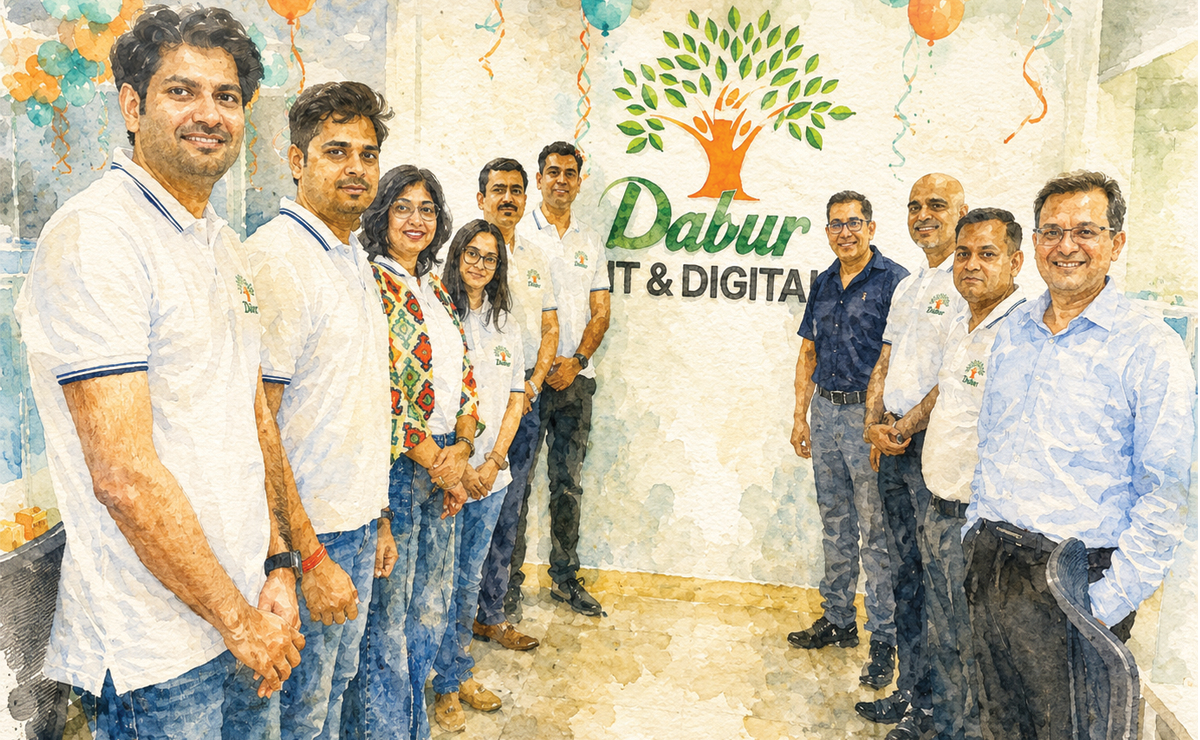
Reinforcing our commitment to build a future-ready, digitally enabled, and globally integrated enterprise, Dabur strengthened its transformation journey with the establishment and expansion of its Global Capability Center (GCC) ecosystem. Designed as a strategic enabler of growth, Dabur’s GCC model focuses on building scalable capabilities, driving operational excellence, and accelerating the adoption of cuttingedge innovation. By bringing together centralised expertise, standardized frameworks, and technologyled solutions, the GCC ecosystem is poised to enhance agility across the organization while ensuring consistency in execution across markets.
At the core of this ecosystem are two key capability centers. Dabur has already operationalized a greenfield Information Technology GCC, which is playing a pivotal role in modernizing systems, streamlining processes, and supporting the Company’s digital backbone. Complementing this, an upcoming Digital Marketing GCC is set to further strengthen Dabur’s consumer engagement capabilities by enabling data-driven, agile, and personalized marketing at scale.
Together, these centers reflect Dabur’s strategic intent to institutionalize global best practices while fostering innovation-led growth. The GCC ecosystem is not only expected to enhance operational efficiency but also serve as a catalyst for faster decision-making and improved responsiveness to evolving consumer and market dynamics.
With this initiative, Dabur continues to build a robust foundation for sustainable, future-ready growth, leveraging technology, talent, and global expertise to stay ahead in an increasingly digital and interconnected world.

1. Information Technology Global Capability Center
(IT GCC)
The Information Technology Global Capability Center (IT GCC) serves as a strategic enterprise capability hub, accelerate digital transformation enabling a resilient, scalable, and intelligence-led technology ecosystem to support Dabur’s growth ambitions across India and international markets.
Integrated Capability Towers
Technology Services: Delivering secure and reliable enterprise technology operations across infrastructure, cloud, enterprise applications, application development, and cyber-security.
Digital & Data Capability: Strengthening data-driven decision making through enterprise data platforms, master data management, advanced analytics, and Generative AI capabilities.
Business Transformation: Accelerating enterprise modernization through architecture-led transformation, product management, innovation mindset and sustainability-focused initiatives.
Strategy & Planning: Driving disciplined strategic program management aligned with Dabur’s goal, application portfolio governance, centralize global business planning, thought leadership and centers of excellence.
Strategic Benefits
- Enterprise Resilience through cyber secure and scalable technology operations
- Digital Acceleration through data lake, analytics, automation, and AI capabilities
- Business Agility through faster technology enablement and execution excellence
- Global Standardization through harmonized frameworks and best practices
2. Digital Marketing Global Capability Center
(Digital Marketing GCC)
The Digital Marketing Global Capability Center (GCC) is envisioned to scale marketing tech capabilities, enhance marketing agility and create differentiated consumer experiences through advanced marketing technology (MarTech) stack, AI-led intelligence, automation for faster execution, Data backed decision making and standardized execution excellence.
Key Pillars:
- Build cutting-edge MarTech tools, Inhouse digital applications and intelligent automation use cases for superior campaign effectiveness.
- Deploy AI-enabled capabilities for content intelligence, audience segmentation, and automated actionable insights.
- Create unified dashboards, benchmarking frameworks, attribution models and real-time performance visibility.
- Develop playbooks and best-practice frameworks to improve media planning and personalization.
- Centralize and intelligent content creation hub at scale.
Value Creation:
- Enhanced marketing ROI
- Top-tier execution standards via playbooks
- Accelerated innovation through emerging MarTech and experimentation
- Cross-market capability enablement
- Future-ready, intelligence-led marketing ecosystem for sustainable growth
The Digital Marketing GCC aligns with Dabur’s vision of building a globally benchmarked, digitally empowered, and consumer-centric enterprise while creating a scalable platform for innovation, operational excellence, and sustainable growth.
 Annual Report 2025-26