
RISK MANAGEMENT
In an increasingly complex and dynamic business environment, effective risk management is central to Dabur’s strategy for sustainable growth and value creation. Our approach is designed to anticipate emerging risks, protect earnings resilience and enable informed strategic choices across markets, brands and operations. By integrating risk assessment into strategy formulation, capital allocation and operational execution, we seek to safeguard stakeholder value while remaining agile in responding to external shifts. This disciplined, forward-looking framework supports continuity, strengthens resilience and underpins confidence in our long-term growth agenda.
RISK GOVERNANCE
The company has a risk governance framework with board level risk oversight. Dabur's Risk Governance framework is structured around a multi-tiered oversight mechanism, as depicted in the accompanying diagram. At the apex, the Board of Directors provides strategic supervision, supported by the Audit Committee and the Risk Management Committee, ensuring robust alignment with regulatory expectations and organisational priorities. Operational execution is driven by the Management Committee (MANCOM), the Chief Risk Officer, and dedicated Risk Coordinators, who institutionalise risk processes across business units. At the ground level, Zonal and Unit Heads, along with Process Owners, are responsible for continuous risk identification, assessment, and mitigation. The circular structure in the image highlights an integrated approach where risk identification flows upward from operational teams, and mitigation strategies cascade downward, ensuring a closed-loop system of accountability and responsiveness. This governance architecture enables Dabur to proactively manage uncertainties and safeguard sustainable business growth.

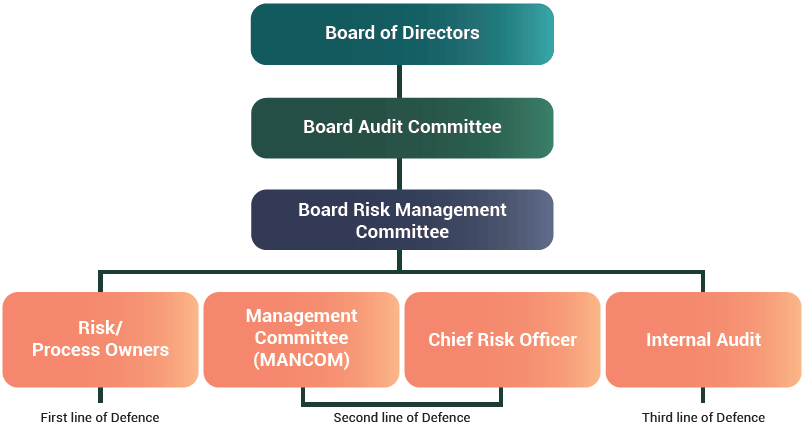
Operational Risk Ownership (first line): Front-line employees and dedicated operational roles including Unit Heads, Zonal Heads and Process Owners own and manage risks.
Risk Management and Compliance Oversight (second line): A dedicated Management committee (MANCOM) and Chief Risk Officer exists at the senior management and executive level which is responsible for setting control standards and oversees compliance with them.
Independent Audit Unit (third line): An internal audit function exists at Dabur that provides independent assurance on the effectiveness of risk management and compliance processes.
RISK MANAGEMENT PROCESS
Risk management is a core organisational discipline at Dabur, integrated across all levels of operations to strengthen resilience and support informed decision making. The Company systematically monitors a wide spectrum of potential risks and opportunities, including political, economic, regulatory, technological, environmental, climate related, public health, currency, and competitive factors. Risk identification begins at the business unit and departmental level, where functional teams assess their operating environment and escalate relevant risks for management oversight.
The Risk Coordinator plays a central role in facilitating coordination among corporate functions, business units, and zonal teams, ensuring consistent monitoring and timely recognition of emerging issues. Risks are categorised as Critical or Non-Critical, with High and Medium risks forming the Critical category and Low risks classified as Non-Critical. Assessment is carried out using a predefined Risk Variable Scale approved by the Risk Management Committee, evaluating risks based on likelihood and impact. The outcomes are plotted on a Risk Heat Map, providing a clear view of prioritisation areas and guiding the design of focused mitigation strategies.
RISK MANAGEMENT FRAMEWORK REVIEW
Dabur's risk management framework is subject to periodic internal and external evaluations to ensure that it remains comprehensive, relevant, and aligned with the Company’s risk profile. The scope of audits is designed in close alignment with the Risk Register, enabling a structured review of identified risks and the associated control environment. Independent Directors provide oversight by reviewing the risk management framework and the key risks presented through the governance structure.
The framework is also assessed by an independent third-party reviewer, providing an external perspective on the adequacy of processes, controls, and governance mechanisms. Key Risk Indicators (KRIs) are incorporated into business planning and monitored regularly through quarterly business reviews, supporting informed decision making and strengthening strategic oversight.
For additional details, stakeholders may refer to the Company’s Risk Management Policy. Please click here.
Some of the key risks identified by us for 2025-26 are represented in the following chart. Relevant mitigation measures have been devised and applied for each risk, depending on the gravity of impact and the likelihood of occurrence.
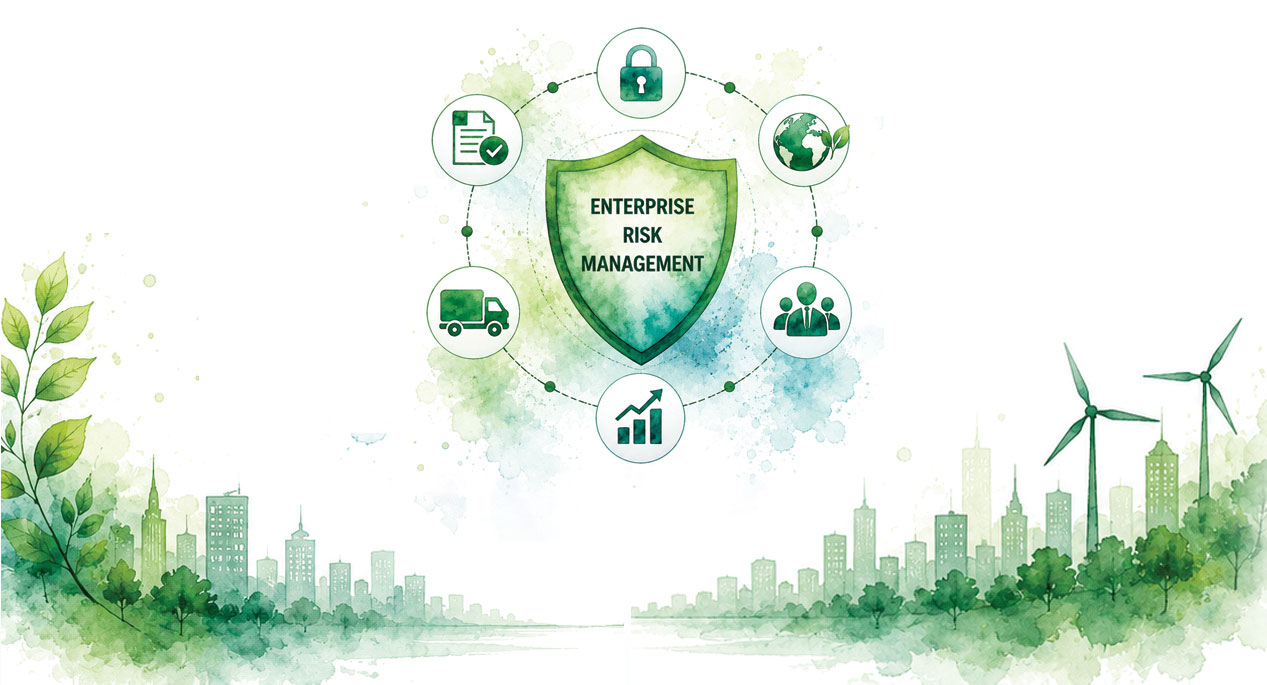
| Through our enterprise-wide risk management framework, we identify and closely track critical risks that could influence our strategy, business continuity and long-term value creation. These risks are reviewed on an ongoing basis and addressed through proactive mitigation measures, helping us remain resilient, agile and well-positioned for sustainable growth. | ||
| Type of Risk | Mitigation Strategies | Capitals Impacted |
Compliance & Regulatory Risks: Dabur operates in an evolving regulatory environment, where changes in interpretation and enforcement may impact operations and financial outcomes. Emerging norms such as FSSAI’s HFSS (High fat, Sugar & Salt) regulations could influence product formulations, labelling and marketing practices, while Access and Benefit Sharing (ABS) obligations related to biodiversity may lead to additional financial commitments. The Company is also addressing certain legacy matters where outcomes remain subject to legal interpretation. In addition, contingent liabilities relating to excise, GST and sales tax – primarily arising from product classification differences - continue to pose potential financial exposure through tax demands, interest and penalties. |
|
 |
Inflation Risk: Ongoing geopolitical tensions, particularly in the Middle East, have heightened volatility across global supply chains, impacting the availability and pricing of key raw materials and packaging inputs. Disruptions in trade routes, energy markets and logistics networks can lead to cost escalations and supply uncertainties. Sustained increases in input costs may exert pressure on operating margins and necessitate calibrated pricing actions, which, in turn, could influence consumer demand in a competitive market environment. |
|
 |
Reputational Risk: In an always-on, digitally connected world, brand perceptions can evolve rapidly. The growing influence of social media amplifies the speed and scale at which information - accurate or otherwise – can spread. This exposes the Company to risks arising from misinformation, activist-led narratives, or heightened public scrutiny of leadership viewpoints, brand associations and marketing campaigns. Such situations can escalate quickly, potentially impacting consumer trust, brand equity and, in certain cases, demand for our products. |
|
 |
Supply Chain Traceability Risk: As a company built on the promise of natural purity, ensuring end-to-end traceability across complex, multilayered supply chains remains a critical focus area, particularly in categories such as honey, where sourcing involves a wide network of beekeepers and aggregators. Variability in sourcing practices, risks of adulteration and evolving regulatory scrutiny pose potential challenges to product integrity and brand trust. Any gaps in traceability or quality assurance could impact consumer confidence and expose the Company to reputational and regulatory risks. |
|
 |
Technology, data privacy and AI Risk: As Dabur advances its digital and AI-led transformation, risks around data security and privacy continue to intensify. Increased handling of Personally Identifiable Information (PII) and Sensitive Personal Data (SPD) across multiple touchpoints heightens exposure to regulatory and reputational risks in case of lapses in governance or cybersecurity. The use of AI tools further introduces risks of unintended data exposure, including potential leakage of confidential or proprietary information through unsecured inputs, outputs or third-party platforms. |
|
 |
Climate Change Risk: Climate change presents a dual challenge to Dabur’s business. Increasingly unpredictable weather patterns - such as erratic rainfall and shifting seasonal cycles – can disrupt demand patterns for seasonal products, leading to potential volatility in topline performance. At the same time, changing climatic conditions may affect the availability and quality of critical herbs, particularly those sourced from high-altitude and tropical regions. Any disruption in the supply of these key inputs could impact production continuity and, in turn, affect product availability and sales. |
|
 |
Human Capital Risk: In an increasingly competitive and rapidly evolving talent landscape, attracting and retaining skilled professionals remains critical to sustaining Dabur’s growth momentum. Shifts in workforce expectations, rising demand for specialised capabilities and changing career aspirations can create challenges in building and retaining a futureready workforce. Any gaps in talent availability or higher attrition in key roles could impact execution agility and organisational continuity. |
|
 |
Strategic & Growth Risk: Sustaining growth in a dynamic and competitive marketplace requires continuous expansion across channels and strategic portfolio strengthening. Dabur faces risks related to channel growth, where evolving consumer preferences, the rapid rise of modern trade and e-commerce, and shifting distribution dynamics may impact sales momentum if not addressed effectively. In parallel, the Company actively evaluates merger and acquisition opportunities to accelerate growth and enter new adjacencies. However, such initiatives carry inherent risks around valuation, integration, cultural alignment and synergies realisation. Any challenges in executing these strategies could impact growth outcomes and value creation. |
|
 |
Non-Critical RisksBeyond critical risks, Dabur also keeps a close watch on a broader set of non-critical risks. While these may not be immediately material, they can influence operational efficiency, stakeholder confidence and long-term resilience. By reviewing these risks regularly, we aim to spot early signals, take timely action and stay ahead of potential challenges. |
||
| Type of Risk | Mitigation Strategies | Capitals Impacted |
Supply Chain & Raw Material Availability Risk: Ensuring consistent availability and quality of key raw materials – particularly medicinal plants and honey – remains challenging due to a fragmented supply base, limited traceability and tightening regulatory standards. In addition, dependence on single-source suppliers, including select third-party vendors, may create concentration risks, exposing the Company to potential supply disruptions, pricing volatility and operational bottlenecks. For honey, evolving global supply dynamics, trade policies, regulatory actions and producer-led activism add further uncertainty to procurement. These factors can impact supply continuity, production planning, cost efficiency and, ultimately, business performance. |
|
 |
Operational Resilience and Safety Risk: Ensuring safe and uninterrupted operations across manufacturing facilities remains critical to Dabur’s business continuity. Fire incidents, in particular, pose significant risks, including potential harm to people, damage to assets and inventory, and disruption to production. In addition, unforeseen events can impact supply continuity and execution stability. Such incidents may lead to financial losses, affect product availability and challenge stakeholder confidence. |
|
 |
Counterfeit Products Risk: The proliferation of counterfeit and look-alike products, particularly in rural and wholesale markets, remains an ongoing challenge for the FMCG sector. Such spurious products not only erode genuine sales and margin realisation but also dilute brand trust built over decades. While quantification remains difficult, the presence of counterfeits can impact channel partner confidence and the morale of frontline sales teams, in addition to posing reputational risks. |
|
 |
Changing Consumer Preferences Risk: Consumer preferences are evolving rapidly, particularly among new-age consumers who increasingly seek modern formats, digital-first engagement and purpose-led brands. Traditional product formats and legacy perceptions may face reduced relevance if not continuously refreshed to align with changing lifestyles, wellness expectations and consumption habits. Failure to anticipate or respond effectively to these shifts could impact brand salience, slow down adoption in younger cohorts and influence longterm growth trajectories. |
|
 |
Product Governance & Safety Risk: As Dabur continues to innovate and broaden its portfolio, ensuring consistent product quality and safety across all offerings remains of paramount importance. Evolving consumer expectations and stricter regulatory standards heighten the need for robust quality controls and compliance frameworks. Increased consumer awareness and digital amplification may also drive higher customer complaints, which, if not addressed promptly, can impact brand trust. Any gaps in product governance could lead to regulatory scrutiny, reputational impact and financial exposure. |
|
 |
Sustainability & ESG Risk: Water availability remains a key operational risk, with certain facilities located in water-stressed regions. Disruptions – particularly for water-intensive processes like juice and Pishti production – could impact production continuity and supply stability. At the same time, limited visibility over environmental footprints across the value chain may pose challenges in managing ESG performance and meeting evolving regulatory and stakeholder expectations. |
|
 |
Packaging & Environmental Compliance Risk: Evolving regulatory frameworks around plastic packaging are increasing the complexity of compliance for FMCG companies. New requirements on sustainability, recyclability and extended producer responsibility (EPR) place additional obligations on packaging design, sourcing and waste management practices. Non-compliance or delays in adapting to the new regulations could lead to financial penalties, operational disruptions and reputational impact. As environmental standards continue to tighten, navigating this shifting landscape remains critical to ensuring both regulatory adherence and long-term sustainable growth. |
|
 |
EMERGING RISKSDabur also actively tracks emerging risks - early-stage developments that may not yet be material but could shape our business over time. By scanning external trends and internal signals, we seek to anticipate potential shifts early and respond in a timely, informed manner, strengthening long-term resilience and strategic agility. | ||
| Type of Risk | Changing Consumer Preferences | Data Privacy |
| Category | Societal | Technological |
| Description |
|
|
| Impact |
|
|
| Mitigating Actions |
|
|
RISK CULTURE
- Targeted actions are taken, wherever relevant, to strengthen early detection and responsiveness to potential risks, including the use of stress testing, scenario planning, and sensitivity analysis.
- An enterprise level risk register is maintained to document identified risks and the corresponding mitigation measures.
- Risks gathered from various functions and risk owners are analysed, measured, and prioritised through a bottom up approach to determine their significance at an enterprise level.
 Annual Report 2025-26